
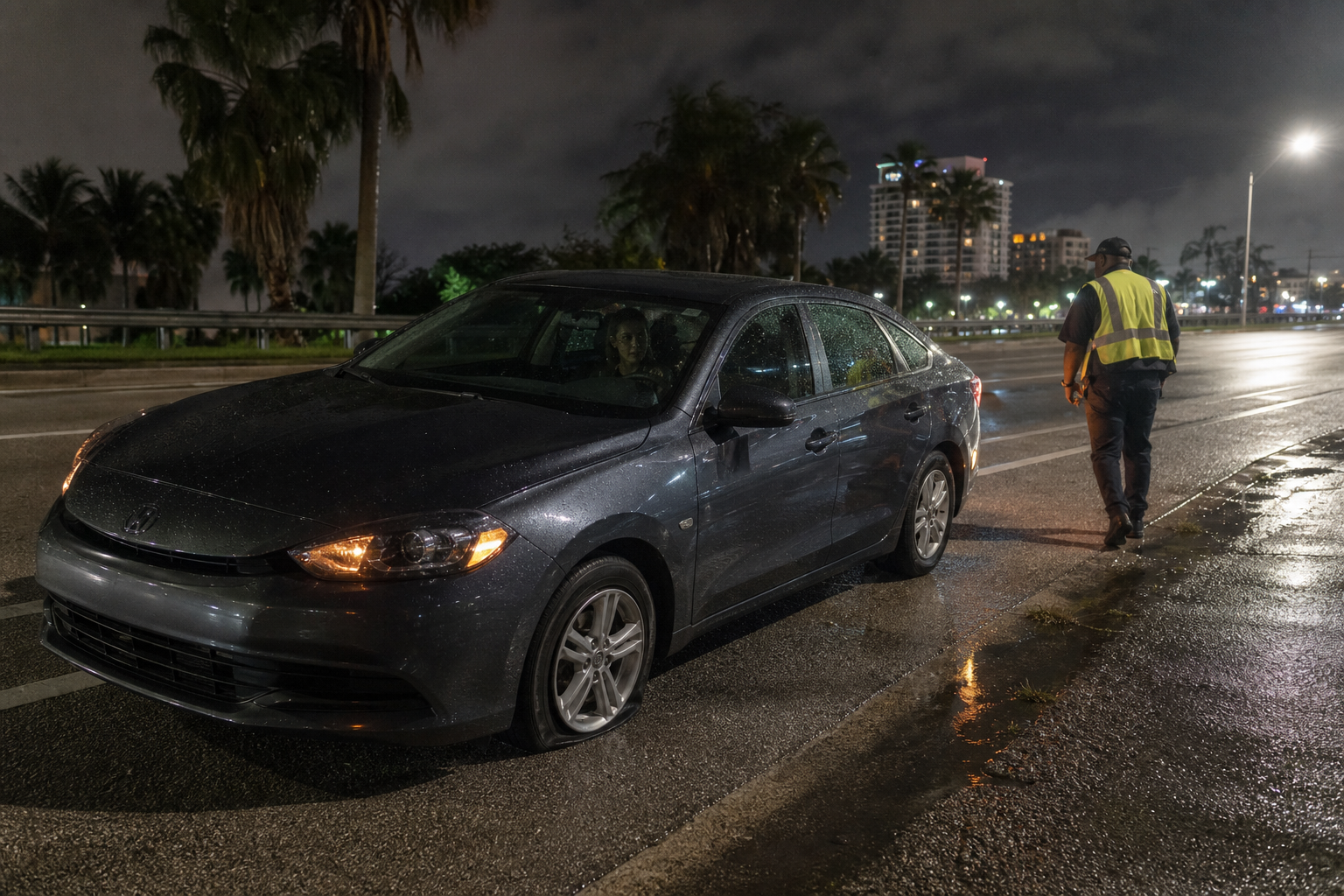
Wait Safely for Flat-Tire Help in West Palm Beach
After dark in West Palm Beach, a flat tire can become a visibility problem before it becomes a tire problem. Rain on the pavement may increase glare, and traffic can be harder to judge from inside a disabled vehicle. Your first task is not to inspect the tire. It is to establish a safer pickup point and tell roadside help exactly what conditions surround you.
The first 10 minutes: reduce exposure before checking the tire
- Control the stop. Ease off the accelerator and avoid sudden steering or braking. If the vehicle can still be controlled, look for firm, level ground completely outside moving traffic. Do not continue far enough to damage the wheel simply to find a more convenient location.
- Make the vehicle visible. Switch on the hazard lights. At night, keep normal exterior lights on when appropriate, but avoid high beams or a phone flashlight aimed toward approaching drivers. Do not walk beside traffic to place warning devices unless there is a clearly safe route and enough separation.
- Secure the vehicle. Shift into park, or select the appropriate gear in a manual vehicle, and apply the parking brake. Wheel direction depends on the slope, curb position, and vehicle orientation. Do not turn the wheels based on a universal rule or reposition the vehicle only to change their direction.
- Choose the safer waiting place. If the vehicle is fully away from traffic, staying inside with doors locked and seat belts fastened is often the lower-exposure choice. Exit only when remaining inside creates a greater danger and there is a protected place you can reach without crossing traffic.
- Account for heat and rain. A closed cabin can heat quickly in Florida conditions. Children, older adults, pets, and medically vulnerable passengers need close attention. If the engine appears undamaged, the vehicle is outdoors, and the exhaust outlet is clear, use climate control as needed. Do not run the engine if there is collision damage, smoke, unusual odor, a fluid leak, rising water, or any concern about the exhaust system.
- Request the right help. Contact flat-tire assistance and describe the tire, vehicle, and roadside position. Do not begin unloading a spare or tools until you know there is a safe working area.
Do
- Keep passengers together and away from the traffic-facing side.
- Preserve phone battery while keeping the phone available.
- Tell the dispatcher immediately if visibility or access changes.
Don’t
- Stand between the disabled vehicle and moving traffic.
- Crawl under the vehicle or inspect the traffic-side tire.
- Accept help that requires an unsafe roadside tire change.
Decision points: stay, relocate, service, or tow
Is the vehicle completely outside the travel lane?
If yes, keep the vehicle secured and evaluate the waiting area. If any part remains in a lane, do not stand outside to direct traffic or inspect damage. Stay belted when that is safer, contact emergency services for the immediate hazard, and explain the obstruction to the roadside dispatcher.
Can a technician reach the flat tire without entering traffic?
A tire change needs stable ground and safe working clearance around the affected wheel. A narrow edge, soft ground, standing water, poor nighttime sight distance, or a traffic-facing flat may make roadside work unsuitable. In that case, ask about flatbed transport instead of pressing for an on-scene tire change.
Is the problem limited to the tire?
Report a bent wheel, scraping, steering changes, impact damage, leaking fluid, smoke, or a vehicle that sits unusually low. Do not assume installing a spare will make the vehicle safe to drive. These conditions may shift the plan from roadside service to vehicle towing.
Has the weather changed the safe choice?
During sudden heavy rain, visibility can drop and water may hide the road edge or unstable ground. Remain in the hard-topped vehicle when it is safely positioned; do not wait beside it with an umbrella near traffic. If water begins rising around the vehicle, treat that as a separate immediate hazard and contact emergency services.
Do you feel personally unsafe?
Keep the doors locked and windows mostly closed. Tell the dispatcher that you are alone, that the area is dark, or that you cannot safely exit. Confirm the arriving provider through the dispatch information before unlocking the vehicle or sharing keys.
What to report so help can find and serve you
A phone location pin is useful, but it should not be the only location detail. Pins can place a vehicle on the wrong side of a divided or multilane road. Give a short, structured report:
- Your name and callback number.
- The phone’s location pin, plus the direction the vehicle was traveling.
- The side of the road, nearest visible address, business entrance, cross street, sign, or other fixed reference.
- Vehicle year, make, model, color, and plate state.
- Which tire is flat and whether it faces traffic.
- Whether the vehicle is fully off the road, partly blocking a lane, on a slope, or standing on soft or wet ground.
- Whether you have an inflated spare, wheel-lock key, jack, or mobility kit.
- Any wheel damage, collision damage, leaking fluid, smoke, unusual odor, or steering problem.
- Passenger needs related to heat, mobility, children, pets, or a medical condition.
- Any gate, height, driveway, parking, or access restriction affecting the pickup point.
If you share live phone location, keep the dispatcher’s text or call open and still provide visual references. Update the location if the vehicle must move.
What roadside help does next
The dispatcher uses your report to separate a workable tire service from a transport need. If there is a usable spare and a safe work area, the responding provider may prepare the vehicle for the spare according to the vehicle and equipment conditions. Stay clear of the work zone and follow instructions about where passengers should wait.
If the tire cannot be handled safely at the roadside, the spare is unusable, or the wheel or vehicle has additional damage, the next step may be a tow. Confirm the intended destination, vehicle access, and whether a flatbed is appropriate before loading begins. Remove essential personal items without stepping into traffic.
Use this final handoff checklist:
- Confirm the provider and vehicle description supplied by dispatch.
- Repeat any new warning light, odor, leak, or weather change.
- Ask where to stand while the technician works or loads the vehicle.
- Confirm the destination before the vehicle is transported.
- Do not drive away until the provider explains the immediate next step.
Questions drivers ask while waiting
Should I shut off the engine while waiting in extreme heat?
Not automatically. Cabin heat can endanger passengers, especially children, older adults, pets, and people with medical needs. Use climate control only when the vehicle is outdoors, the exhaust is clear, and there is no damage, leak, smoke, unusual odor, or other sign that running the engine may be unsafe.
What should I do if heavy rain starts before help arrives?
Stay inside a safely positioned hard-topped vehicle rather than standing near traffic. Keep the hazard lights on, watch for rising water, and update dispatch if the shoulder floods, visibility collapses, or the pickup point becomes inaccessible.
Is sharing my phone location enough?
No. Send the pin, then state your direction of travel, side of the road, and a visible fixed reference. This helps prevent confusion on divided or multilane roads and gives the driver a way to verify the correct approach.
What if part of my vehicle is still blocking a lane?
Do not inspect the tire or attempt to direct traffic. Stay belted if remaining inside is the safer option, contact emergency services about the traffic hazard, and tell roadside dispatch exactly how much of the vehicle is exposed.
What if someone approaches before the dispatched provider arrives?
Keep the doors locked and speak through a slightly opened window only if needed. You do not have to exit or hand over keys. Verify the provider using the name, vehicle description, or arrival information sent by dispatch.